


How to Protect Wholesale Pricing Online Effectively

A retailer calls because its advertised price is no longer competitive. Your sales team sees the same SKU selling for less on Amazon. The instinct is to send takedowns, issue warnings, or tighten a marketplace policy. Those actions may remove a visible problem, but they rarely protect wholesale pricing online for long if the product is still leaking from the same part of the distribution network.
Wholesale price protection is not primarily a listing-management issue. It is a channel-control issue. When unauthorized sellers can repeatedly obtain authentic inventory and undercut authorized partners, the damage reaches beyond a single Buy Box. Retailer confidence falls, margin expectations shift, and the brand's ability to maintain a disciplined market position weakens.

Counter Diversion helps brands regain control of their marketplace channels through visibility, source intelligence, and enforcement management. We don't believe in high-pressure sales tactics or one-size-fits-all solutions. Our goal is to have honest conversations about the challenges your brand is facing, help you understand the root causes, and determine whether Counter Diversion or another approach is the right fit. If you'd like to discuss your marketplace challenges, schedule a consultation here
Why Online Price Erosion Starts Upstream
Unauthorized marketplace sellers do not need permission to create a pricing problem. They need inventory. That inventory may come from a distributor selling outside agreed territories, a retailer clearing excess units through an unapproved channel, a promotional buyer purchasing at a discount, or a supply-chain partner moving product without adequate controls.
This is why monitoring alone has limited value. Monitoring tells a brand what is happening in public. It can identify a seller, a SKU, a price, and a marketplace. It cannot, by itself, explain how that seller acquired product or prevent the next seller from appearing after the first listing disappears.
For manufacturers and brand owners, the commercial consequences are immediate. Authorized retailers may stop supporting the assortment when they cannot maintain agreed margins. Field sales teams spend time defending price discrepancies instead of growing accounts. Consumers receive inconsistent product information, service, and return experiences. Over time, even premium products can begin to look interchangeable when every marketplace search results page is filled with discounted offers.
The problem is often worse when a brand treats every low-price seller as identical. Some sellers are opportunistic resellers moving a small number of units. Others are fed by a sustained source of diverted inventory. The appropriate response depends on which situation exists. A broad enforcement campaign may temporarily clear small sellers while leaving the high-volume source untouched.
Protect Wholesale Pricing Online by Finding the Source
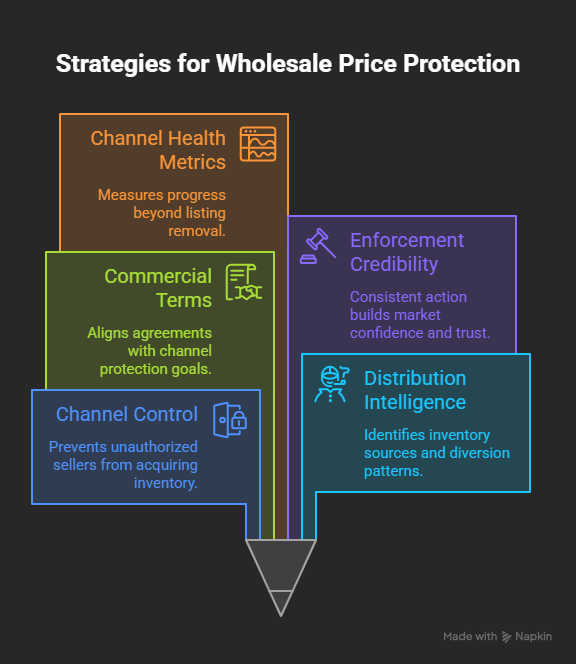
The most durable way to protect wholesale pricing online is to connect marketplace evidence to distribution intelligence. That requires a process designed to answer a harder question than, “Who is selling?” The critical question is, “Where is the inventory coming from?”
Start with the products causing real channel damage
Not every unauthorized listing deserves the same level of attention. Prioritize SKUs that have meaningful wholesale volume, persistent marketplace undercutting, high retailer exposure, or strategic importance to the brand. A discontinued item sold by one small reseller is different from a current-season product that is consistently below authorized retail pricing.
Look for recurring patterns: the same seller names across multiple products, sudden inventory spikes after a promotion, matching photos or copy between sellers, or regional clusters of underpriced offers. These patterns help separate isolated resale from organized diversion.
Build evidence that can support action
A screenshot of a low listing price is useful, but it is only a starting point. Effective investigations preserve the details needed to establish a pattern: seller identity, listing history, SKU and variation data, fulfillment method, inventory availability, price changes, marketplace location, and repeated activity over time.
This evidence matters internally as much as externally. Distribution teams need enough specificity to review account activity, shipment patterns, discount usage, returns, and unusual ordering behavior. Legal and marketplace teams need a factual record when policy violations, trademark misuse, or other enforceable issues are present.
The goal is not to make assumptions about a suspected account. It is to narrow the investigation until the brand can take proportionate, defensible action.
Compare marketplace activity with channel events
Price erosion often follows an internal event that seemed harmless at the time. A large closeout order, an overly broad promotional discount, a distributor expansion, a retailer account with declining sell-through, or inventory allocated beyond a partner's realistic demand can all create product that later reaches unauthorized channels.
Brands should review marketplace movement alongside wholesale sales data. When did unauthorized inventory appear? Which products were affected? Which accounts received unusual volumes, special pricing, or inventory that did not align with their normal sales profile? This is where source-of-diversion analysis becomes more valuable than generic seller tracking.
A brand does not always need certainty before taking a first corrective step. It does need enough evidence to avoid damaging productive relationships or punishing the wrong party. The strongest programs combine marketplace observations with account-level investigation rather than relying on either data set alone.
Put Distribution Rules Behind Your Pricing Policy
A MAP policy can help establish expectations, but it does not control who receives inventory. Nor does it solve every form of marketplace undercutting. A seller may technically comply with a minimum advertised price while still being unauthorized, confusing customers, or destabilizing a retail partner's territory. Conversely, a seller pricing below MAP may be operating because a distribution agreement was never specific enough to prohibit the behavior.
The practical work is to align commercial terms with the channel you want to protect. Authorized accounts should understand whether marketplace resale is allowed, which marketplaces are permitted, whether product can be supplied to third parties, how closeouts must be handled, and what documentation is required when inventory changes hands.
Terms should also be enforceable in practice. If an account violates marketplace restrictions and there is no inspection right, consequence, or process for reviewing suspected diversion, the policy becomes a statement of preference. Clear agreements give sales, operations, and leadership a common basis for action when a violation occurs.
There is a trade-off. Overly restrictive rules can make authorized partners feel constrained, particularly in categories where retailers rely on flexible inventory management. Vague rules, however, transfer the risk to the brand and to partners who follow the rules. The right standard depends on product category, account type, margin structure, and the level of marketplace exposure. What matters is that the policy reflects commercial reality and is applied consistently.
Make Enforcement Credible, Not Performative
Marketplace enforcement has a role, especially when listings misuse brand assets, violate marketplace rules, or clearly conflict with documented reseller restrictions. But enforcement should follow a disciplined escalation path. Start with verified facts, communicate expectations directly when appropriate, preserve records, and apply the remedies supported by the relevant agreement or platform policy.
The same principle applies inside the channel. A sales representative should not be left to negotiate a diversion issue alone with a major account. Leadership, sales, legal, operations, and marketplace teams need agreed ownership of the response. Without that coordination, an account may receive mixed messages while unauthorized inventory continues to move.
Credibility comes from consistency. If a brand identifies diversion but repeatedly makes exceptions without a defined business reason, the market learns that the policy is negotiable. If the brand responds fairly, documents the issue, and follows through, authorized partners have more confidence that their investment in the brand will be protected.
Measure Channel Health, Not Just Removed Listings
A falling count of unauthorized listings can look like progress while the underlying supply remains active. Better measures connect enforcement activity to business outcomes. Watch the number of persistent sellers by priority SKU, price variance from authorized channels, recurring seller reappearances, time to identify likely sources, and the percentage of marketplace activity tied to known or suspected diversion patterns.
Retailer feedback is another important signal. Are key accounts seeing fewer price conflicts? Are they willing to support launches, hold inventory, and invest in merchandising? A protected price architecture should improve the quality of the authorized channel, not merely reduce the number of visible listings.
Counter Diversion approaches this work as a root-cause problem: identify the unauthorized supply path, give brands actionable intelligence, and support corrective action that lasts longer than a single takedown cycle. That distinction matters when marketplace disorder is affecting revenue, retailer relationships, and brand value at the same time.
The next time an unauthorized seller undercuts your wholesale network, treat the listing as evidence rather than the entire problem. The brand that follows the inventory back to its source is in a far better position to protect price, preserve partner trust, and regain control of its distribution decisions.


Comments